

Free whitepaper
VMware Migration to KVM and Proxmox
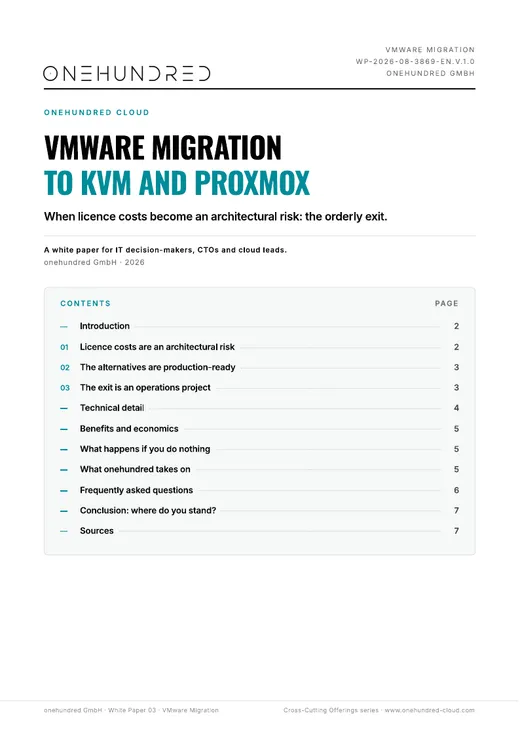
When licence costs become an architectural risk: the orderly exit. Seven pages by Andreas Hankel, CTO onehundred, for IT decision-makers facing their next VMware renewal.

Andreas Hankel
CTO onehundred · Former CTO idealo · CIO of the Year 2014
„I wrote this whitepaper because Broadcom/VMware’s licensing and pricing policy put me in front of this decision myself in practice, and because I wanted to show that Proxmox is not a playground, but a production-ready, HA-capable enterprise alternative.“
- Former CTO idealo: Nearly nine years, 2016 to 2025.
- CIO of the Year 2014: Mid-market category, awarded by IDG, CIO-Magazin and Computerwoche. As VP Technology at ImmobilienScout24 he brought server operations back in-house, built a private cloud and switched the virtualisation platform while in live operation.
- Over 30 years in IT: Since 1990, including 18 years at Fiducia IT, then ImmobilienScout24 and idealo.
„What has been created is exemplary and shows the way for designing the systems of the future.“
Manfred Broy, jury CIO of the Year 2014
Request the whitepaper
You will receive the PDF by email at your business address.
The situation
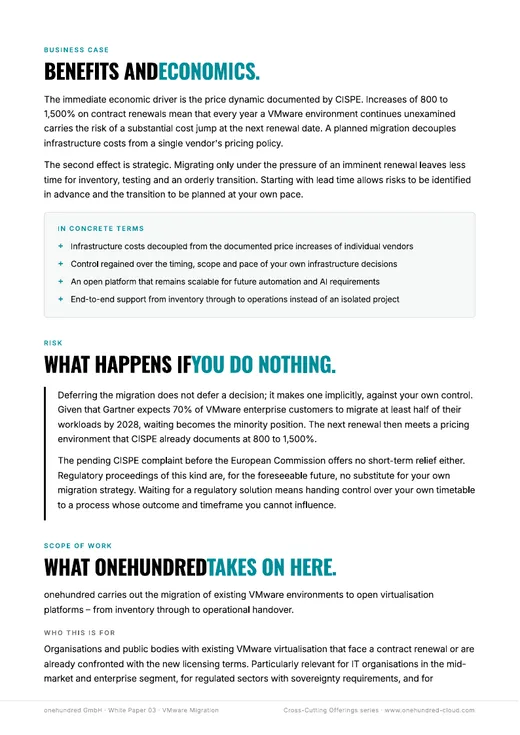
Up to 1,500 % more expensive: why you should not wait for the next renewal.
Since Broadcom acquired VMware in November 2023 there are no perpetual licences left. What that means for renewals is documented, not asserted.
800 to 1,500 %
Price increase on VMware contract renewals, documented by the European cloud association CISPE.
Quelle: CISPE
70 %
of VMware enterprise customers are expected by Gartner to migrate at least half of their workloads by 2028.
Quelle: Gartner, cited in White Paper 03
March 2026
CISPE filed a competition complaint against Broadcom with the European Commission. The German IT user association VOICE has also complained about abuse of market power.
Quelle: CISPE, VOICE
What's inside
Is KVM ready to carry your operations? And where do you start?
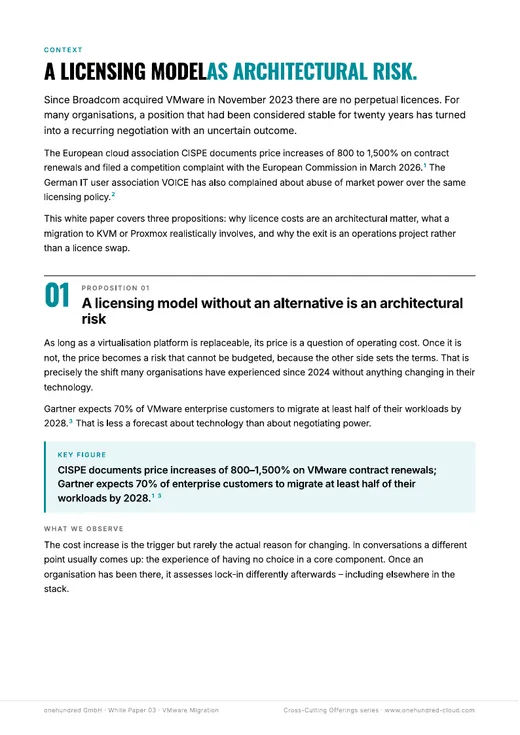
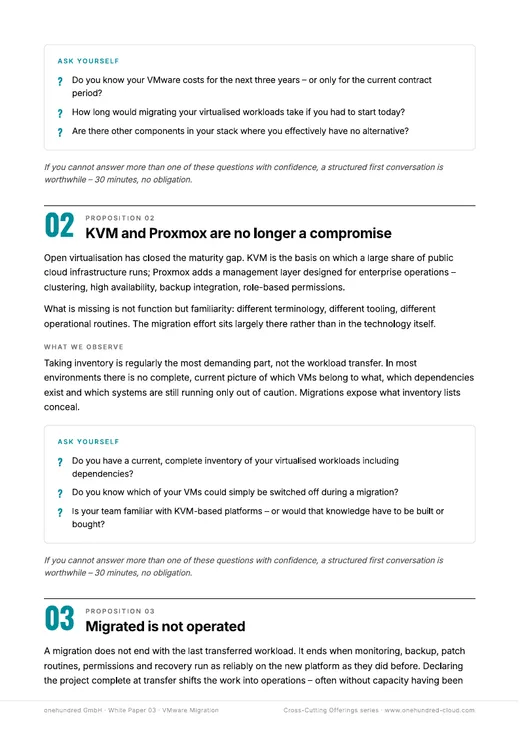
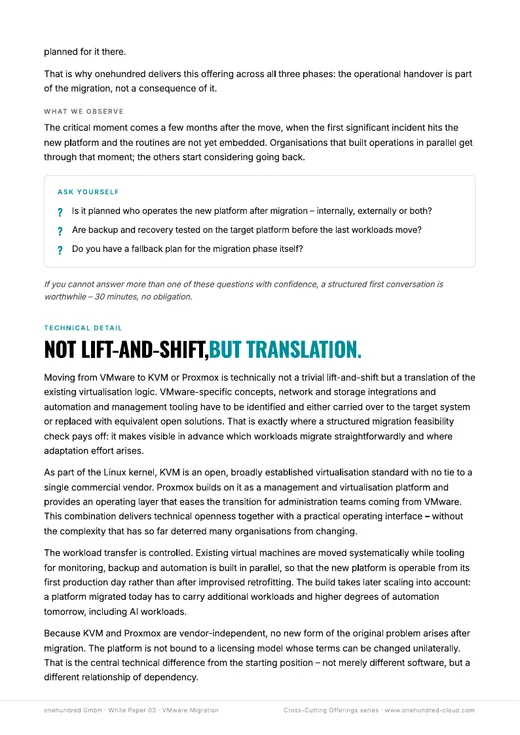
The whitepaper covers three propositions: why licence costs are an architectural matter, what a migration to KVM or Proxmox realistically involves, and why the exit is an operations project rather than a licence swap. Each proposition comes with three questions to place your own position within minutes.
01
A licensing model without an alternative is an architectural risk
As long as a virtualisation platform is replaceable, its price is a question of operating cost. Once it is not, the price becomes a risk that cannot be budgeted, because the other side sets the terms. That is precisely the shift many organisations have experienced since 2024 without anything changing in their technology.
02
KVM and Proxmox are no longer a compromise
Open virtualisation has closed the maturity gap. KVM is the basis on which a large share of public cloud infrastructure runs; Proxmox adds a management layer designed for enterprise operations: clustering, high availability, backup integration, role-based permissions. What is missing is not function but familiarity: different terminology, different tooling, different operational routines.
03
Migrated is not operated
A migration does not end with the last transferred workload. It ends when monitoring, backup, patch routines, permissions and recovery run as reliably on the new platform as they did before. Declaring the project complete at transfer shifts the work into operations, often without capacity having been planned for it there.
Further chapters
- Technical detail: not lift-and-shift, but translation
- Benefits and economics
- What happens if you do nothing
- What onehundred takes on here
- Frequently asked questions
- Conclusion: where do you stand?
- Sources
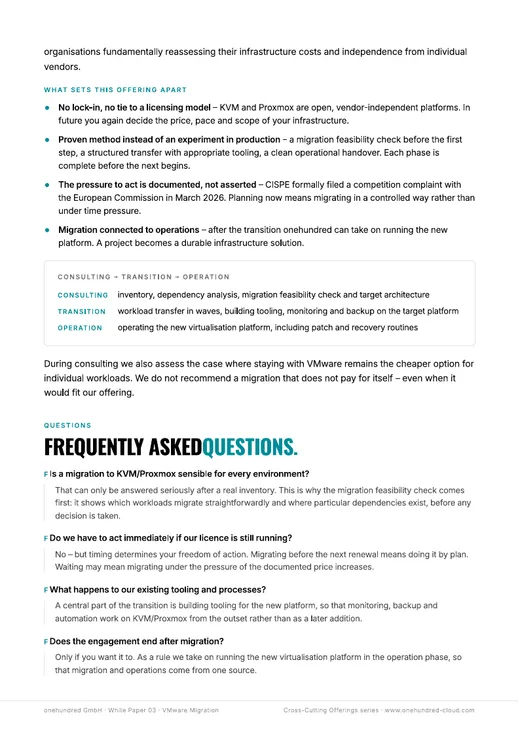
What onehundred takes on
Consulting, transition, operation.
onehundred carries out the migration of existing VMware environments to open virtualisation platforms, from inventory through to operational handover.
Consulting
Inventory, dependency analysis, migration feasibility check and target architecture
Transition
Workload transfer in waves, building tooling, monitoring and backup on the target platform
Operation
Operating the new virtualisation platform, including patch and recovery routines
During consulting we also assess the case where staying with VMware remains the cheaper option for individual workloads. We do not recommend a migration that does not pay for itself, even when it would fit our offering.
Questions
Frequently asked questions.
Is a migration to KVM/Proxmox sensible for every environment?
Do we have to act immediately if our licence is still running?
What happens to our existing tooling and processes?
Does the engagement end after migration?
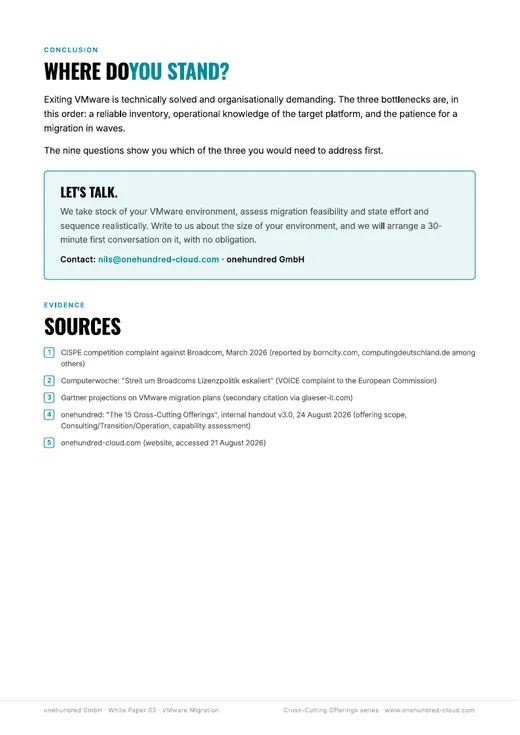
Conclusion
Where do you stand?
Exiting VMware is technically solved and organisationally demanding. The three bottlenecks are, in this order: a reliable inventory, operational knowledge of the target platform, and the patience for a migration in waves. The nine questions in the whitepaper show you which of the three you would need to address first.
- A reliable inventory
- Operational knowledge of the target platform
- The patience for a migration in waves
Why now
Taking inventory is the most demanding part of a migration. Every week of lead time is a week less pressure at the next renewal.