

01 Solution · Private cloud
Private cloud services in your own data centre, operated around the clock
Self-service, elasticity and automation are properties of the platform, not of the hyperscaler. We build your private cloud in your own data centre, in colocation or in German data centres, migrate your systems onto it and run it 24/7. Data, location and access stay with you.
 Book a call
- Platform
- Proxmox, KVM or Kubernetes on Debian. All open source, no proprietary layer.
- Location
- Your own data centre, colocation, or German data centres that are ISO 27001 certified.
- Operations
- 24/7 with on-call cover, monitoring and alerting, patch and escalation management.
- Exit
- Configuration lives in Git repositories that belong to you. No lock-in, not to us either.
02 Starting point
On premise is not a step backwards, and not a guarantee either
Three sentences from almost every first conversation on this subject.
“For this workload the numbers no longer add up.”
Egress charges, cross-zone traffic and premium support tiers were rarely in the business case that justified the move. They surface once the volume grows.
“In our own data centre this takes days again.”
The business side is used to minutes. Without self-service and automation you trade a dependency problem for an efficiency problem, whatever the cost sheet says.
“The server sits in our building, so we are in control.”
Control means traceable access, documented configuration, a reproducible restart and the ability to change operating partner. Location alone delivers none of it.
The reason for going to the public cloud was rarely the location, it was the operating model. Bring workloads back and lose that model, and you have cut the bill and slowed the organisation down.
03 The solution
Private cloud as a service, on infrastructure you control
The building blocks a modern cloud provider offers, on infrastructure you own or control inside a European legal space. Each block is bookable on its own.
Location analysis and workload assessment
We assess your largest workloads one by one: public cloud, on premise cloud or hybrid. The result is a target architecture with costs and risks, not a decision of principle.
A platform with self-service and automation
Provisioning, scaling and configuration run through infrastructure as code and self-service interfaces instead of tickets. That layer separates a private cloud from classic server operations.
Virtualisation and Kubernetes where it pays
Proxmox or KVM for classic workloads, Kubernetes to CNCF standard where it pays. No Kubernetes by default: several of our largest projects deliberately run without it.
Governance and security inside the architecture
Access control, network segmentation and audit readiness belong in the platform, not in an add-on fitted later. Who holds administrative access is documented, providers included.
Managed private cloud, 24/7 with on-call cover
The call at three in the morning reaches us. Monitoring and alerting, patch and escalation management and ongoing advice belong to it. Not a portal that leaves you on your own again.
Hybrid cloud solutions for load peaks
Elasticity without holding capacity permanently: peaks run through a connection to a European data centre. Hybrid is the normal case here, not a compromise.
04 How it works
Consulting, transition, operations: one contract, one team, one responsibility
No patchwork of consultancy, systems integrator and operator. Whoever runs it in the end plans differently.
Phase 01
Consulting
Location analysis, assessment per workload, the decision between on premise and hybrid. It ends with a target picture including costs and risks, and the first go or no-go before anything changes.
Phase 02
Transition
We build the platform including its automation layer, then migrate service by service with a fallback path. Your systems keep running, and there is no cut-over date on which everything tips.
Phase 03
Operations
Managed operations at the service level your teams know from the public cloud: monitoring, security, FinOps and automation, 24/7, with on-call cover.
In projects so far, two to six months passed between breaking ground and a productive target environment, depending on the estate. We build nothing we would not want to operate ourselves.
05 Proof
Four organisations whose platform runs where it belongs
Four different starting positions: consolidation onto one private cloud, the way out of the public cloud, load peaks, heightened data protection requirements.
 konversionsKRAFT Digital marketing, around 80 employees, SaaS platform with terabit data volumes. Consolidated onto a highly available private cloud with a redundant database cluster. Proxmox · Percona · GitLab
  Innotech The application ran in Azure, with performance problems and a cost curve that only pointed upwards. Two months from breaking ground to the new production environment on private cloud, then 24/7 with patch and escalation management. Proxmox · Debian · HAProxy · PostgreSQL
  Aerosoft Their own dedicated infrastructure, but brutal load peaks at product launches and on Black Friday. Availability permanently above 99.9 per cent, the complete stack from network to database from one source. Proxmox · HAProxy · Percona · Redis
 06 Read on and check
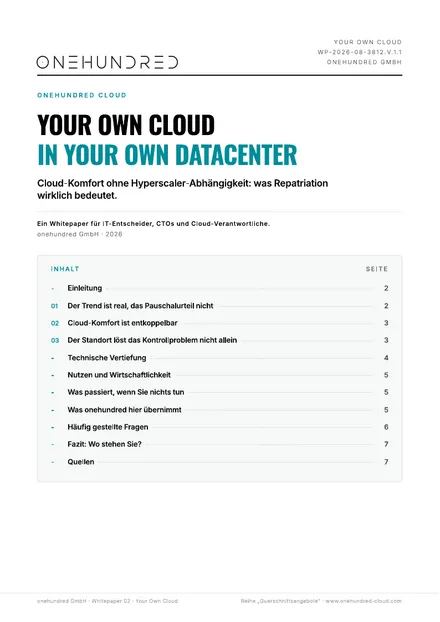
Free whitepaper · 7 pages
Your Own Cloud in Your Own Datacenter
By Andreas Hankel, CTO onehundred. Download in exchange for your e-mail address, no sales call.
07 To be honest
Four objections you are having right now
“Is a cloud of our own not a step back into the classic data centre?”
Only if the platform layer is missing. Self-service, elastic scaling and API automation are properties of the platform above the hardware, not of a hyperscaler. We build that layer, so your teams carry on as before, on infrastructure whose location and access you decide.
“We do not have a data centre of our own.”
You do not need one. We run the same platform in German data centres that are ISO 27001 certified, or in colocation. As a hosted private cloud you take the infrastructure from us and buy no hardware. If you do have a data centre, we bring the stack to you.
“Then we depend on you instead of the hyperscaler.”
Only if we pulled you onto a platform of our own. We do not. The stack is open source and close to CNCF, your configuration lives in Git repositories that belong to you, and any competent provider can take operations over. The price for us: we have to earn it again every month.
“We do not want to bring everything back.”
You should not. For most estates hybrid is the permanent target architecture, not a transition. We assess every workload on its own, and where one belongs in the public cloud we say so.
08 Fasttrack analysis

Start with the one workload that is giving you the most trouble
Name the one workload where cost, control or compliance is hurting. You get an assessment of whether a private cloud is the right home for it, and if not, we say so.
15 minutes · not a sales call · book directly in the calendar
09 Frequently asked questions
What else you may want to know
What does a private cloud cost to run?
Do we need a data centre of our own?
Where are the servers?
Is onehundred ISO 27001 certified?
Which workloads should we bring back from the public cloud?
Do we have to move to Kubernetes for this?
Can AI workloads with sensitive data run on this platform?
What happens if we want to change operating partner?
10 Insights · Private cloud in your own data centre
Further reading
The technical groundwork behind this solution, without the sales part.