

01 Solution · VMware replacement and open operations
The VMware alternative that someone still runs afterwards
Since the Broadcom acquisition in November 2023 there are no perpetual VMware licences any more. Your VMware alternative is Proxmox VE or KVM, and we move the vSphere estate across service by service, with a fallback path and no cut-over date. Then we take over operations, around the clock and with on-call cover.
 Book a call
- Consulting
- Inventory, dependency analysis and a migration readiness check. Go/no-go before anything is moved.
- Migration
- Service by service with a fallback path, no cut-over date on which everything tips.
- Operations
- 24/7 with on-call cover, patch and escalation management.
- Platform
- Proxmox VE or KVM on Debian, no forced Kubernetes. All open source.
02 Starting point
At the renewal it is Broadcom that sets the date, not you
Three sentences that come up in almost every conversation about replacing VMware.
“We do not know what the next three years will cost.”
Perpetual licences ended in November 2023. The European cloud association CISPE has documented price rises of 800 to 1,500 per cent on contract renewals and filed a competition complaint with the European Commission in March 2026.
“We do not know exactly what is running in there.”
A complete, current inventory of the virtual machines and their dependencies is missing. Which VM belongs to which service, and which one only still runs out of caution, is settled by the stocktake. It is regularly the most laborious part of a migration.
“Migrated is not the same as operated.”
The critical moment arrives a few months after the move, at the first serious incident. If monitoring, backup, access rights and recovery are not solid by then, going back to VMware is suddenly on the table.
None of this is a technical problem. Open virtualisation has closed the maturity gap, so the effort sits in the inventory, the operating routines and plain familiarity.
03 The solution
An open source VMware alternative, migrated and operated
Consulting, transition and operations from one source: a single point of contact from the stocktake to the on-call rota. The handover into operations is part of the migration, not a consequence of it.
Migration readiness check
We inventory the vSphere estate, classify the workloads and analyse dependencies. The result is a plan with sequence and effort, including the systems you can simply switch off.
A target architecture, not a lift and shift
Storage, network and automation are translated, not copied. We also assess staying on VMware for individual workloads: a migration that does not pay for itself is one we do not recommend.
Migration in waves
The transfer follows criticality, wave by wave, with a fallback path per service. Your estate keeps running. A big bang migration of an entire data centre over one weekend is rarely a sensible plan.
Tooling from the first day in production
Monitoring, backup and automation are built on the target platform alongside the transfer. Not retrofitted once the first incident arrives.
24/7 operations with on-call cover
The call at three in the morning lands with us, not with your team. Patch and escalation management are part of it, and so are maintenance windows at night and on public holidays.
Proxmox support and hosting
Already running Proxmox? We take an existing cluster into our on-call cover while everything stays live. Or you rent Proxmox servers from us in German data centres. In your own data centre we run the same stack.
04 How it works
Five phases. You can step out at every transition
Go/no-go at every transition: you can stop without anything in production having been moved.
Phase 01
Analysis
We look at what actually runs. Not at what the documentation says.
Phase 02
Target picture
A proposal with costs and risks. The first go/no-go decision falls here.
Phase 03
Test environment
Built and load-tested while your VMware estate keeps running untouched.
Phase 04
Migration
Service by service, with a fallback path. No cut-over date on which everything tips.
Phase 05
Operations
24/7, monitoring, patch and escalation management, ongoing advice.
Whoever runs it at the end plans differently. We do not build anything we would not want to operate ourselves afterwards.
05 Proof
Four environments that run on Proxmox
Proxmox and KVM carry classic virtualisation in our projects, under load and also where the customer has no platform people of their own.
 Innotech The application ran in Azure, with severe performance problems and a cost curve that only pointed upwards. Two months from breaking ground to the new production environment on private cloud, followed by 24/7 with patch and escalation management. Proxmox · Debian · HAProxy · PostgreSQL
  Aerosoft Their own dedicated infrastructure, but the load peaks are brutal: product launches and Black Friday. Availability permanently above 99.9 per cent, the complete stack from network through virtualisation to database from one source. Proxmox · HAProxy · Percona · Redis
  konversionsKRAFT Digital marketing, around 80 employees. SaaS platform with terabit data volumes, consolidated onto a highly available private cloud with a redundant database cluster. Proxmox · Percona · GitLab
  Net Connection IT services and enterprise content management, 55 employees. Continuous 24/7 operations without a platform engineer or systems architect in house. Proxmox · MariaDB · Jenkins
 06 Read on and check
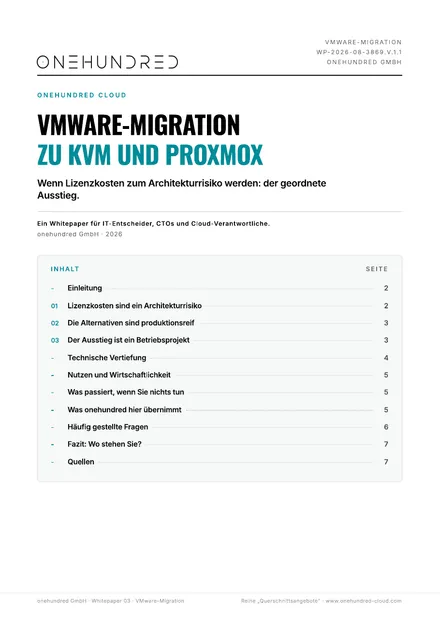
Free whitepaper · 8 pages
VMware Migration to KVM and Proxmox
By Andreas Hankel, CTO onehundred. Download in exchange for your e-mail address, no sales call.
07 To be honest
Four objections you are having right now
“Is Proxmox really enterprise grade?”
The maturity gap is closed. Proxmox VE provides clustering, high availability, live migration, integrated backup and role-based access. At Aerosoft, Proxmox carries an environment with Black Friday load peaks, permanently above 99.9 per cent availability. What is missing is not function but familiarity: different terms, different tools, different operating routines.
“Our licence still has time to run. Why now?”
Because the timing decides how much freedom you have. Plan before the next renewal and you migrate in an orderly way, and you negotiate with an alternative in hand. Wait, and you may end up migrating under time pressure. Gartner expects around 70 per cent of VMware enterprise customers to move at least half their workloads by 2028.
“Then we are just swapping one vendor for the next.”
Only if we pulled you onto a platform of our own. We do not. The stack is open source, your configurations sit with you as Git repositories, and any competent service provider can take it over. No lock-in, not even to us. What to check that against is set out in our piece on vendor lock-in.
“Our team only knows vSphere.”
That is the most honest objection. Someone has to know Linux, storage on Ceph or ZFS and the Proxmox API. So we accompany the first migration waves with coaching, and anyone who wants to hand operations over entirely hands them to us. After our engagement your team is more independent, not less.
08 Fasttrack analysis

A conversation with someone who has held your job
You tell us how large your VMware estate is and when the contract runs out. We tell you what comes first in your situation, and whether the switch pays for itself at all. Not a sales meeting.
15 minutes · not a sales call · book directly in the calendar
09 Frequently asked questions
What else you want to know
What is the best alternative to VMware after the Broadcom acquisition?
How do you migrate VMware to Proxmox?
How long does a VMware replacement take?
Is there an ESXi alternative that supports live migration and shared storage?
Do you take over existing Proxmox clusters?
Can I simply rent Proxmox servers from you?
What happens to our tooling for monitoring, backup and automation?
How fast do you react to an incident?
10 Insights · VMware replacement and open operations
Worth reading before you decide
Replacing VMware is a special case of a more general problem. These pieces put it in context.